For more information on our content creation process, view our Editorial Policy.
The fitness industry in the UK continues to expand, with personal training representing one of its fastest-growing segments.
But getting an accurate count of personal trainers proves surprisingly complex; the answer depends on whether you’re counting businesses or people.
Two Ways to Measure: Businesses vs. Individuals
Personal Training Businesses
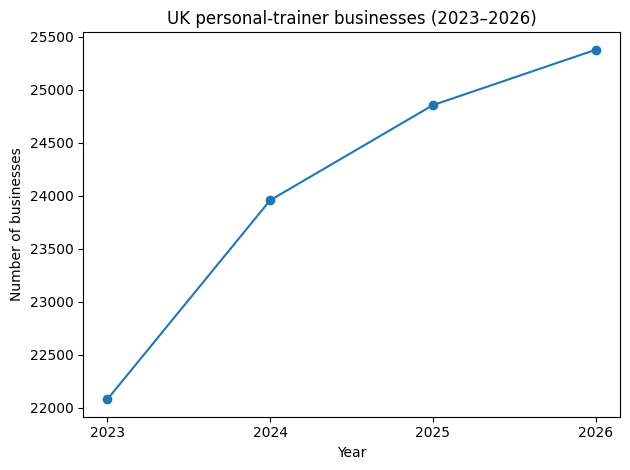
Industry data from IBISWorld tracks registered personal training businesses in the UK, showing steady growth over recent years:
2023: 22,082 businesses
2024: 23,959 businesses (up 8.5% from 2023)
2025: 24,856 businesses (up 3.7% from 2024)
2026: 25,378 businesses (estimated, based on a 2.1% forecast growth rate)
This represents a 15% increase from 2023 to 2026, reflecting both the growing demand for personalised fitness services and the relatively low barriers to entry for starting a personal training business.
People Working as Fitness Instructors
When counting individuals rather than businesses, the picture changes. According to labour market figures from Statista, there were approximately 67,400 fitness and wellbeing instructors employed in the UK as of December 2025.
This broader category encompasses personal trainers, group fitness instructors, and other fitness professionals. Not all of these individuals operate as independent businesses, many work for gyms, leisure centres, or fitness chains.
Why the Numbers Differ
The gap between roughly 25,000 businesses and 64,400 employed fitness professionals highlights several realities of the industry:
Many personal trainers work as employees rather than running their own businesses.
Some fitness professionals hold multiple roles, teaching classes while also offering one-on-one training. The “businesses” count includes sole traders who may be one-person operations, while the employment figure captures everyone working in the sector regardless of their business structure.
The Growth Trajectory
The personal training sector has shown resilience and consistent expansion. The 8.5% year-on-year growth from 2023 to 2024 suggests strong consumer demand for personalised fitness guidance, though growth rates are moderating slightly as the market matures.
Industry forecasts predict continued expansion through 2026, albeit at a more measured pace of around 2% annually. This growth reflects several factors: increasing health awareness, an ageing population seeking specialised fitness support, and the proliferation of boutique fitness studios and online training services.
Data Limitations
These figures come with important caveats.
The business counts from IBISWorld represent registered enterprises in the personal training industry category, they don’t capture part-time trainers working informally or those who haven’t registered as businesses.
The employment figures, while based on Statista, rely on survey data and occupational classifications that bundle different types of fitness professionals together.
The Bottom Line
If you’re asking how many personal training businesses exist in the UK: approximately 24,856 as of 2025, with growth to around 25,000-25,500 expected by 2026.
If you’re asking how many people work as personal trainers and fitness instructors, approximately 67,400 as of late 2025, though this includes various fitness professional roles beyond just personal training.
The UK’s personal training sector remains a vibrant and expanding part of the fitness economy, whether measured by business registrations or workforce headcount.
Other content you might like
Business & MarketingIndustry Insights
How to Get Personal Training Clients: A Step-by-Step Guide That Actually Works
Key Takeaways Here are the essential strategies that will help you build a thriving personal training business and convert prospects...
For more information on our content creation process, view our Editorial Policy. People’s fitness goals keep changing faster than ever. While 76% of...